From Dock to Ward: Operationalising Hospital Back-of-House Logistics

The problem hospitals live with every day
Walk through the back of house of most Australian hospitals and the pattern repeats: docks sized for a smaller hospital decades ago, central stores overflowing into corridors, and nurses spending real clinical hours chasing stock that should already be on the ward. Trace Consultants' recent analysis of hospital BOH logistics https://www.traceconsultants.com.au/thinking/hospital-boh-logistics-dock-to-ward-optimisation puts a name to this: dock to ward is a systems problem, not a departmental one, and it shows up as cost, lost clinical time, and avoidable safety risk.
The chain typically breaks down at the same points, regardless of hospital size: ordering and replenishment run on stale catalogues and untouched stock thresholds; deliveries arrive at the dock unscheduled and unmanaged; freight arrives consolidated rather than sorted to ward, so staff redo work a distribution centre should have done once; ward and imprest stores drift from actual consumption; return flows for waste and linen compete for the same corridors as inbound goods; and very few hospitals can answer basic questions about their own internal logistics because the data was never captured in the first place.
Each failure point compounds the others. Sporadic deliveries make sorting harder, sorting errors erode ward trust, and eroded trust drives the maverick ordering that makes the delivery profile even less predictable.
Two disciplines, one problem
Fixing this requires two things that rarely sit in the same team: the strategic and operational design capability to model demand, redesign the operating model and size the physical infrastructure correctly; and the technology layer that makes the redesigned process actually happen on the dock, every day, without relying on manual discipline that erodes over time.
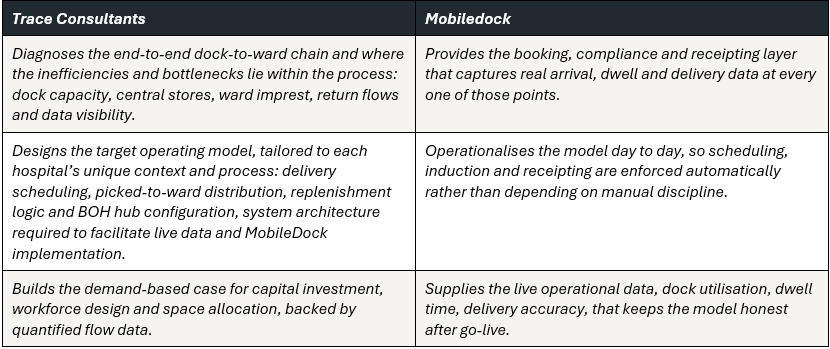
Trace Consultants brings the first. Their BOH logistics practice diagnoses the dock-to-ward chain end to end, quantifies where cost and time are being lost, and designs the target operating model, whether that's a delivery booking regime, a picked-to-ward distribution arrangement, or a consolidated BOH hub for a new build. Mobiledock brings the second: a dock scheduling, compliance and delivery platform already running across distribution centres, retail and industrial sites, purpose-built to enforce exactly the kind of process discipline a redesigned operating model depends on.
Put together, the two capabilities close the gap that usually stalls hospital BOH improvement programs: a well-designed operating model with no mechanism to keep it running, or a booking tool with no strategic model behind it.
Where the two capabilities meet
Beyond the Dock: extending the model to the ward
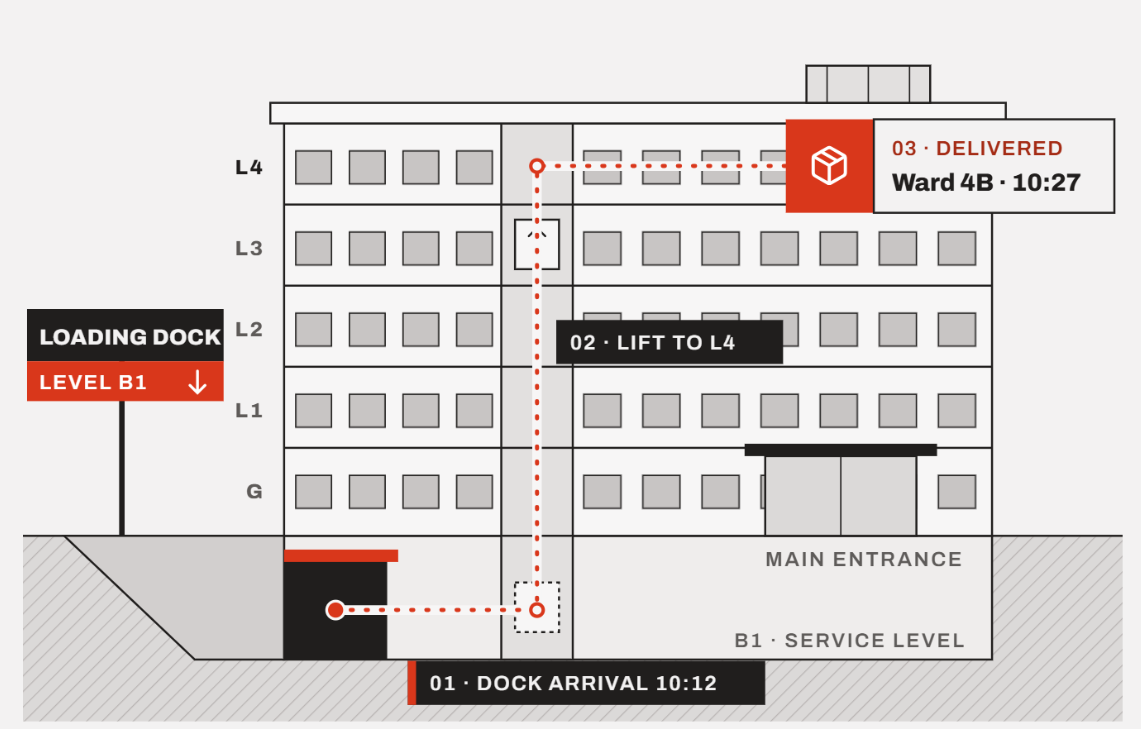
Most dock scheduling technology stops at the loading dock: a booking is made, a vehicle arrives, freight is unloaded, done. That leaves exactly the gap Trace's research identifies as one of the most consistent failure points in hospital logistics: what happens to a delivery between the dock and the point of consumption is usually untracked.
Mobiledock's Beyond the Dock capability extends the booking and compliance workflow past the dock itself. A delivery is scanned on arrival, checked against what was ordered, and then tracked through to its actual destination, a ward, a department, an internal tenant, with a digital proof of delivery captured at that final point rather than at the dock. Discrepancies, damaged stock or missed items are flagged immediately, with a timestamped record, instead of being discovered hours or days later when a ward manager notices something is missing.
This is the direct technology counterpart to what Trace's diagnostic work calls out as a design requirement: picked-to-ward delivery, a genuine chain of custody from supplier to point of use, and internal logistics data that lets a hospital actually measure cost to serve per ward or per bed instead of relying on anecdote.
What this looks like in practice
- A redesigned delivery schedule (Trace) is enforced through structured dock and ward booking windows, so arrivals are smoothed rather than unmanaged (Mobiledock).
- A picked-to-ward distribution model (Trace) is executed and verified through scan-based receipting that follows the delivery to its actual destination (Mobiledock).
- Replenishment and imprest settings rebuilt from real consumption data (Trace) are kept honest by live delivery, dwell and turnaround data captured automatically at every step (Mobiledock).
- A BOH hub or dock design case for a new build or redevelopment (Trace) is quantified using real operating data from comparable live sites already running on Mobiledock.
Where to start
Trace's guidance for operators is to begin with a structured dock-to-ward diagnostic: map the chain, quantify the volumes, time and labour at each step, and identify the constraints doing the most damage. That diagnostic is also the right starting point for this partnership, because it tells us exactly where operational technology will have the fastest, most measurable impact, whether that's a dock booking system to end unmanaged arrivals, or a Beyond the Dock rollout to finally close the loop between the dock and the ward.
If you're a hospital or health network operator weighing up where to focus first, or a project team designing BOH into a new build, we'd welcome the conversation.
Get in touch with Trace Consultants for a dock-to-ward diagnostic, or with Mobiledock to see how Beyond the Dock operationalises the resulting model on your site.